Availability of Multidrug-Resistant Ornithobacterium rhinotracheale in Broiler Flocks with Swollen Head Syndrome in Iraq: Prevalence, Phylogeny, and Therapeutic Implications

Article Sidebar
-
Nitrobacterium rhinotracheale, antimicrobial resistance, multidrug resistance, broilers, Iraq, Swollen Head Syndrome
Abstract
Background: The cause of Swollen Head Syndrome (SHS) in poultry is multifactorial and includes Nitrobacterium rhinorrhea (ORT) as the primary bacterial agent. The world is seeing Occupationally/Multi-Resistant (AMR) as a more widespread threat to its control. In Iraq, a major poultry-producing country, no recent data are available on ORT susceptibility profiles.
Methods: Three cross-sectional studies on 30 SHS affected broiler flocks (8,000-11,000 birds) in Diyala Province, Iraq. ORT was first isolated from tracheal swabs and sinus exudates using selective culture, and was subsequently confirmed by 16S rRNA PCR and locus sequencing. The confirmed isolates (n=7) were ascertained for antimicrobial susceptibility against 10 agents using a disc diffusion method. The co-circulation of the avian metapneumovirus subtype B (aMPV-B) by reverse transcription was in a single exercise polymerase chain reaction (RT-PCR).
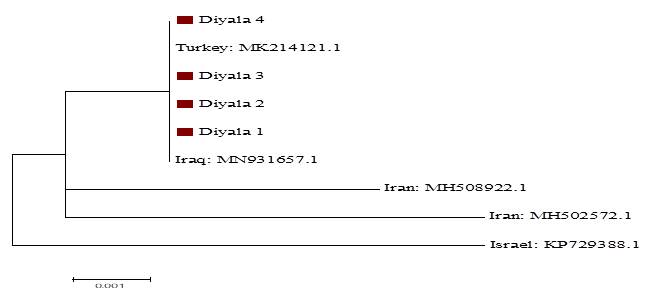
Results: Out of the total, 7 flocks were confirmed cases of ORT (23.3% prevalence). All isolates (100%) were calculated to be multidrug resistant (MDR) to at least 3 classes of antimicrobials. Of the three classes, resistance was found to be universal (100%) to enrofloxacin, erythromycin, and lincomycin. Of the remaining classes, high resistance rates were found to be approximately 85.7 to ampicillin and 71.4% to oxytetracycline. On the other hand, susceptibility was retained to florfenicol (85.7%) and doxycycline (71.4%). Eighteen phylogenetic strains were analyzed. The Iraqi ORT strains clustered with serotype A isolates from Iran and Turkey. amp-B was detected in fifteen (16.7%) flocks, of which 3 (10%) were co-infected with ORT. However, no significant epidemiological association was found (p=0.325).
Conclusions: This is the first report from Iraq and it reveals a significant AMR crisis in ORT, with isolates being resistant to all first-line antimicrobials. The findings, therefore, warrant an urgent change to evidence-based therapy employing florfenicol or doxycycline and greatly highlight the necessity for regional poultry industry antimicrobial stewardship to be implemented.
Full text article
References
Cecchinato, M., Catelli, E., Lupini, C., & Ricchizzi, E. (2004). A conventional RT-PCR for the detection of avian metapneumovirus subtype B. Journal of Virological Methods, 116(2), 209-211.
CLSI. (2018). Performance Standards for Antimicrobial Disk and Dilution Susceptibility Tests for Bacteria Isolated From Animals (5th ed.). CLSI supplement VET01S. Clinical and Laboratory Standards Institute.
Ercan, D., Atalay, M. M., Yılmaz, A., & Timurkan, M. Ö. (2021). Investigation of antimicrobial resistance and virulence genes of Ornithobacterium rhinotracheale isolates from turkeys. British Poultry Science, 62(2), 200-207.
Gharibi, D., Ghadimipour, R., & Mayahi, M. (2018). Detection and antimicrobial susceptibility of Ornithobacterium rhinotracheale from broiler chicken flocks in Iran. Veterinary Research Forum, 9(2), 151–155.
Hung, A. L., & Alvarado, A. (2001). Phenotypic and molecular characterization of isolates of Ornithobacterium rhinotracheale from Peru. Avian Diseases, 45(4), 999-1005.
Jung, A., Metzner, M., & Ryll, M. (2020). Comparison of diagnostic methods for the detection of Ornithobacterium rhinotracheale in broiler flocks. Avian Pathology, 49(2), 174-181.
Kumar, S., Stecher, G., Li, M., Knyaz, C., & Tamura, K. (2018). MEGA X: Molecular Evolutionary Genetics Analysis across computing platforms. Molecular Biology and Evolution, 35(6), 1547-1549.
Turan, N., Yilmaz, A., Beytut, E., & Ozkul, A. (2022). Molecular detection and antimicrobial resistance profiles of Ornithobacterium rhinotracheale in Turkish broiler flocks. Avian Diseases, 66(1), 1-8.
van Empel, P., & Hafez, H. M. (1999). Ornithobacterium rhinotracheale: a review. Avian Pathology, 28(3), 217-227.
van Veen, L., Hartman, E., & Fabri, T. (2000). Ornithobacterium rhinotracheale and avian pneumovirus in broilers: a field study. Tijdschrift voor Diergeneeskunde, 125(22), 689-691.
WHO. (2019). Critically Important Antimicrobials for Human Medicine (6th revision). World Health Organization.
Zhu, Y., Li, H., Shen, Z., Yang, J., & Wang, S. (2022). Antimicrobial resistance in Ornithobacterium rhinotracheale: A review. Frontiers in Veterinary Science, 9, 1018478.
Authors

This work is licensed under a Creative Commons Attribution 4.0 International License.